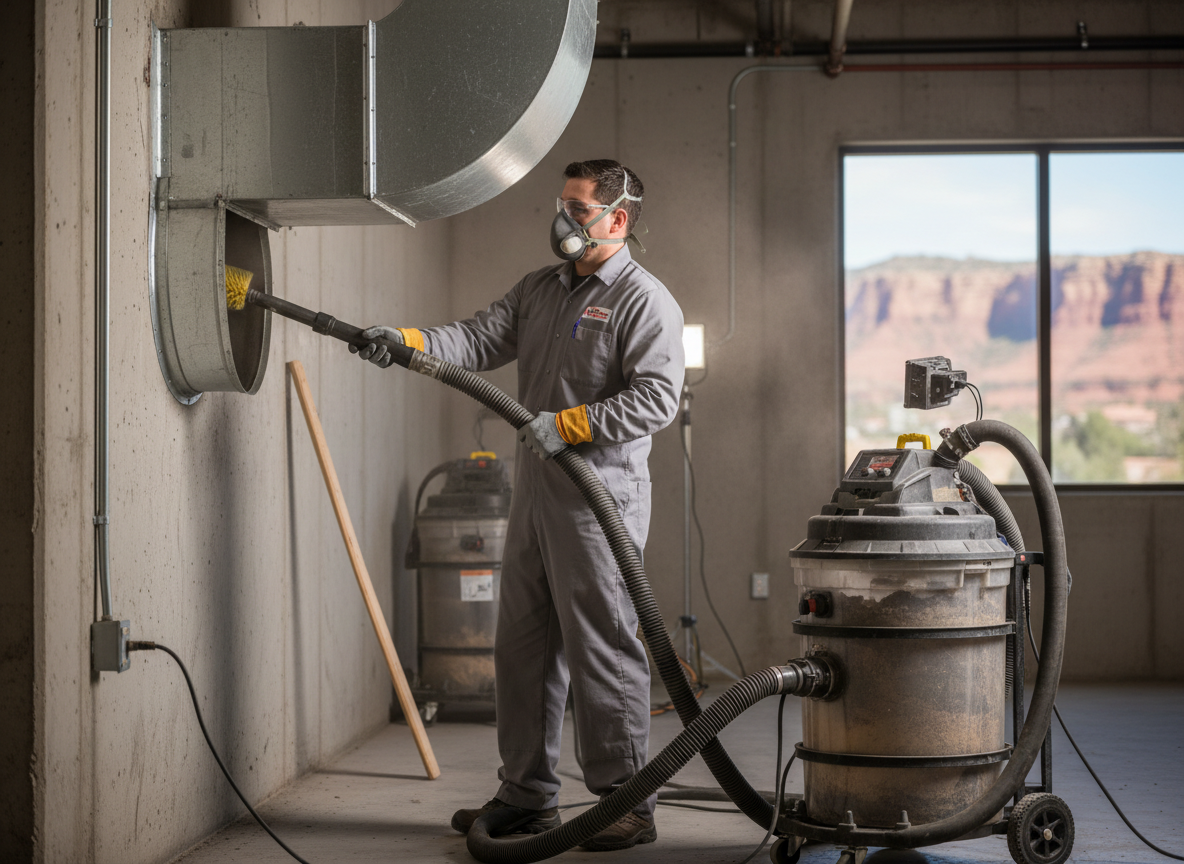
Camp Verde sits in Yavapai County at the edge of the high desert where warm days and cool nights drive constant air exchange through HVAC systems. Homes near Fort Verde State Historic Park and along routes to Montezuma Castle National Monument often date to the mid-twentieth century with original duct runs that collect fine red silt blown from surrounding mesas. Professional duct cleaning here requires removing that layered dust without disturbing aging flex duct or sheet metal seams common in Middle Verde properties.
Wind patterns between Camp Verde and nearby Cottonwood and Sedona push pollen and desert particulates into return vents year-round. Systems in single-story ranch homes built on the valley floor pull more airborne grit during spring and fall when temperature swings are largest. Technicians must account for longer duct runs that travel through crawl spaces where soil moisture fluctuations can loosen insulation and allow additional debris entry.
Standard truck-mounted equipment works well but must be calibrated for the lower humidity levels that make static cling worse inside metal ducts. Crews typically start at the farthest register and work back to the furnace to prevent re-deposition of loosened material. In homes with additions common around Camp Verde, separate zone ducts often need individual attention because they were installed at different times and trap dust differently.
Residents along Finnie Flat Road and in Middle Verde frequently notice reduced airflow after monsoon season when dust storms coincide with increased cooling demand. Professional cleaning restores balance only when every branch line is accessed and the furnace blower compartment is cleared of the fine silt that bypasses standard filters.
Technician insight
In Camp Verde, the thing that catches most people out with professional duct cleaning is how the fine red dust from surrounding mesas settles deep inside the original flex duct runs of homes built before the 1990s near Fort Verde. Those older lines collapse easily under aggressive brushing and the dust reappears within a season if the main trunk is not pulled completely clean first.
Restricted airflow after monsoon season
A Middle Verde homeowner reported weak cooling after heavy dust storms. Inspection showed thick silt packed in the return trunk and several collapsed flex sections running under the house. We isolated the system, agitated and extracted the debris line by line, then replaced the damaged flex. Airflow returned to normal and the homeowner reported even temperatures again within two days.
How it works
- 1
Initial Inspection
Technician examines all accessible registers, returns, and the furnace compartment to map duct layout and note any damaged sections typical in older Camp Verde homes.
- 2
System Isolation
Registers are sealed and the system is isolated to contain debris while negative pressure is applied through the main trunk lines.
- 3
Agitation and Extraction
Rotary brushes and compressed air tools dislodge built-up dust while the vacuum removes material, paying special attention to long runs common in valley-floor properties.
- 4
Final Verification
Each branch is checked for remaining debris and airflow is tested before the system is returned to normal operation.
Pricing
Upfront quotes based on number of runs, system age, and access conditions in Camp Verde and Middle Verde homes.