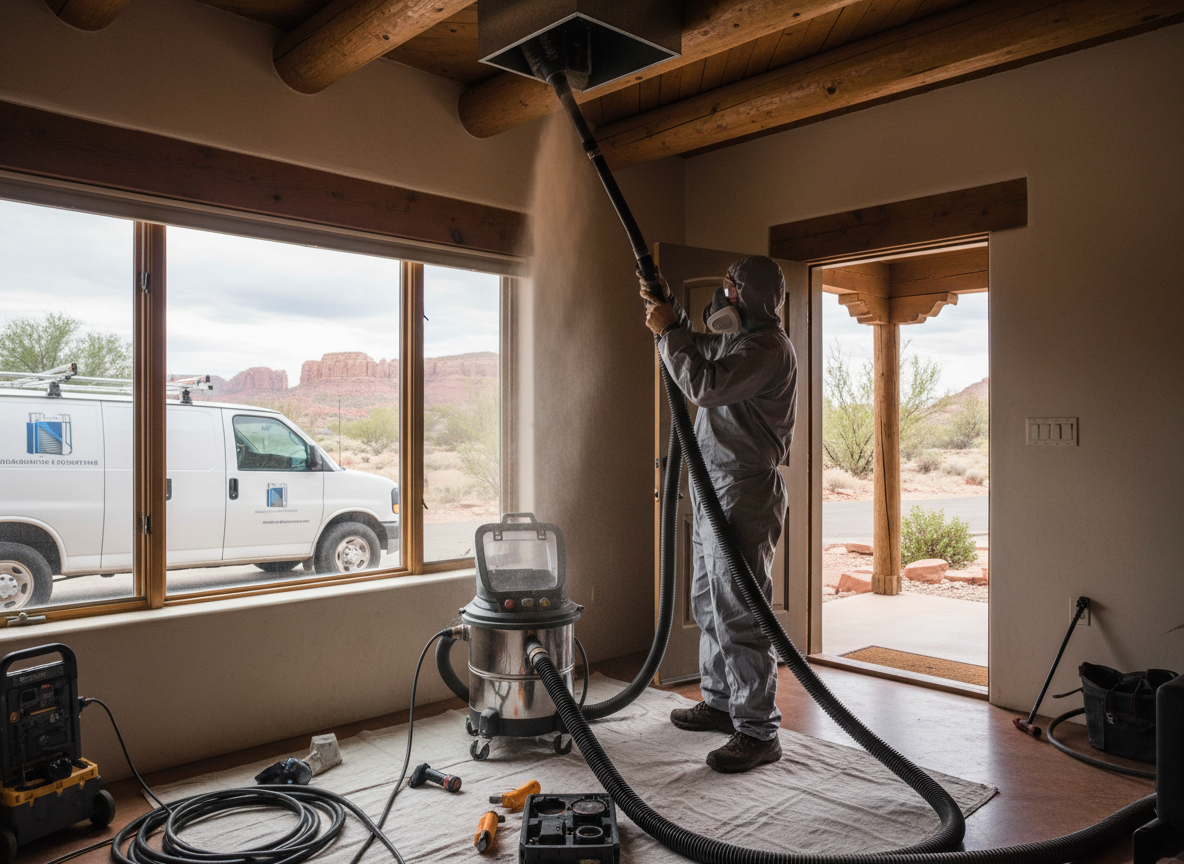
Camp Verde sits in Yavapai County at the edge of the high desert where warm days stir fine red dust and cool nights pull it through unsealed joints in older ductwork. Homes near Fort Verde State Historic Park and Montezuma Castle National Monument often date to the mid-twentieth century with rigid metal trunks that collect pollen from surrounding juniper and cottonwood stands. Professional air duct cleaning here requires negative-air machines rated for fine particulates plus brushes sized for the narrow branch runs common in these single-story ranch houses.
Sedona and Cottonwood residents notice similar buildup after monsoon season when wind carries extra grit across the valley. In Middle Verde the soil is sandy and alkaline so any moisture that reaches the ducts can leave a crust that standard shop-vac methods miss. Technicians must isolate the system at the air handler, seal all registers, and use HEPA filtration to keep the dust from re-entering living spaces during the job.
The work also involves checking for loose insulation inside flex runs that older homes in Camp Verde commonly have. Removing that material without tearing the duct liner prevents future clogs and keeps airflow balanced across the house. Because nights cool quickly, condensation can form on metal surfaces if the system runs right after cleaning, so final steps include a short test cycle to confirm dryness before the homeowner restarts normal operation.
Technician insight
In Camp Verde the thing that catches most people out with professional air duct cleaning is how fast the fine red dust from the high desert settles back into older flex runs after monsoon winds, especially in Middle Verde homes where the sandy soil tracks in on boots and gets pulled through unsealed joints near Montezuma Castle.
Dusty Returns Near Fort Verde
A Middle Verde homeowner noticed reduced airflow after several dry windy weeks. Inspection showed thick red dust packed in the return plenum and loose insulation inside two flex runs. The team isolated the system, agitated the lines, and extracted the material under negative pressure. Airflow returned to normal and the homeowner reported quieter operation the next morning.
How it works
- 1
System Inspection
Technician maps every accessible trunk and branch line from the air handler at 522 Finnie Flat Rd address outward through the home.
- 2
Register Sealing
All vents are covered and the system is placed under negative pressure to contain dust within the ductwork.
- 3
Agitation and Extraction
Rotating brushes and compressed air dislodge debris while the vacuum removes it through the main trunk.
- 4
Final Verification
Registers are reopened and airflow is checked at multiple points to confirm the system moves air evenly.
Pricing
Pricing varies by duct length, number of returns, and access difficulty typical in Yavapai County homes.