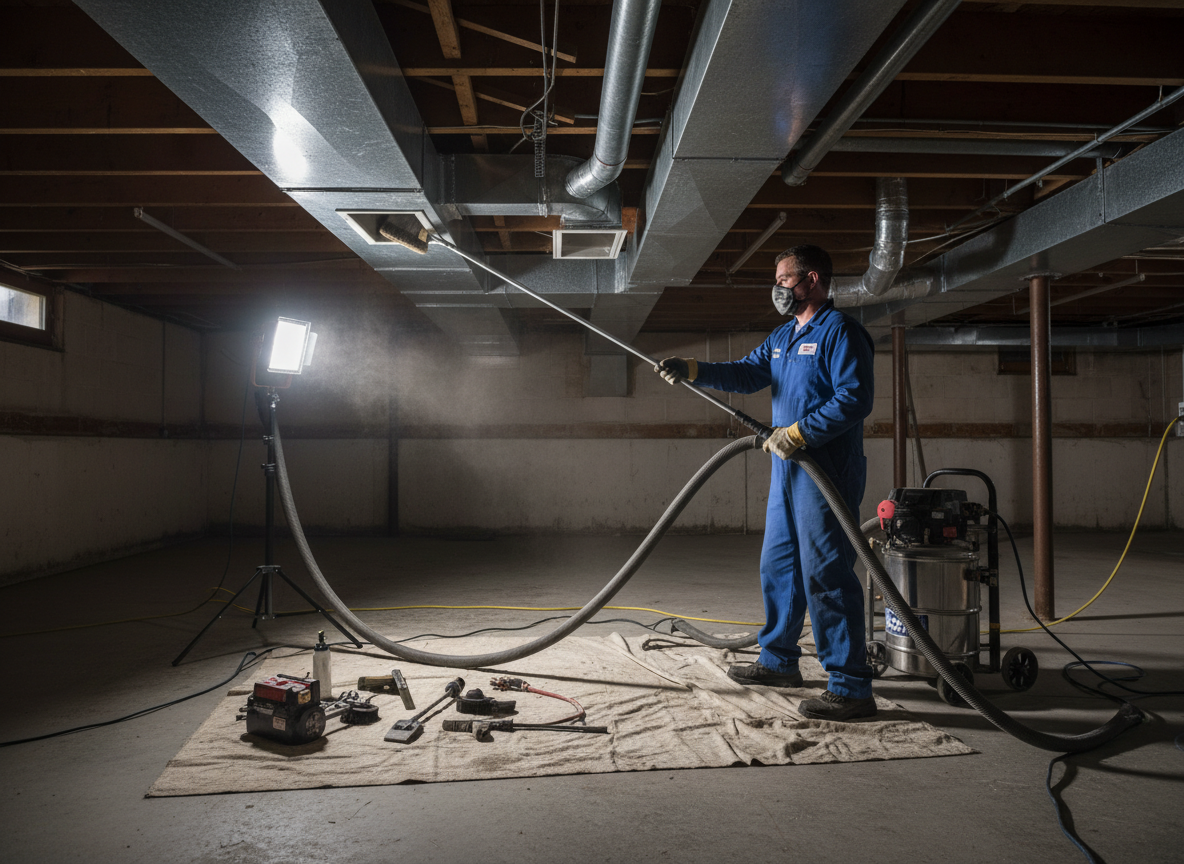
Camp Verde and Middle Verde homes built before the 1970s often feature full basements that trap airborne silt carried from the surrounding Yavapai County terrain. These lower levels sit closer to the soil line, where cool night temperatures cause moisture to condense on metal ducts during warm days, creating sticky layers that standard attic or main-floor cleaning misses. Technicians must use angled whips and negative-air machines positioned at the 522 Finnie Flat Rd address to pull debris without disturbing the stone foundations common in properties near Fort Verde State Historic Park.
High desert winds funnel dust through vents that open at ground level in many Middle Verde residences, pushing fine particles deep into basement runs that connect to living spaces above. Unlike Sedona or Cottonwood homes with crawl spaces, these basements require full disassembly of register boots to reach elbows where silt packs tight against the pipe walls. Failure to address this leads to re-circulation when furnaces cycle during the cool evenings typical after warm afternoons.
Access challenges arise in homes near Montezuma Castle National Monument where additions have narrowed basement stairwells and lowered ceilings. Equipment must be broken down into smaller sections and reassembled on site to avoid scratching finished surfaces. Proper sealing of access points after cleaning prevents the return of valley dust that settles during monsoon outflows.
Seasonal Considerations
High desert temperature swings between day and night increase condensation risk in basement ducts during shoulder seasons, making spring and fall the most effective times for thorough cleaning before winter heating begins.
Technician insight
In Camp Verde, the thing that catches most people out with basement air duct cleaning is the fine silt that settles below grade during monsoon season and packs into elbows that sit right at soil level in pre-1970 homes near Fort Verde. Homeowners often forget these lower runs when they schedule regular service, so the dust just gets pulled back upstairs once the furnace kicks on during cool nights.
Monsoon silt in Middle Verde basement
A homeowner in Middle Verde noticed musty air only when the system ran after evening temperature drops. Inspection revealed heavy silt packed in the lowest trunk line elbows where the duct sat near the foundation. The crew broke down the equipment to fit the narrow stair access, extracted the debris with contained negative air, and resealed the boots. Airflow improved and the musty odor disappeared.
How it works
- 1
Initial Basement Assessment
Technicians inspect all accessible duct runs, registers, and return paths in the basement while noting any moisture stains or restricted elbows common in older Camp Verde construction.
- 2
Negative Air Setup
Equipment is positioned to create containment from the basement level outward, protecting the rest of the home from disturbed silt during the cleaning process.
- 3
Mechanical Agitation and Extraction
Rotating brushes and compressed air whips loosen packed debris from duct walls, followed by HEPA vacuum extraction through the main trunk lines.
- 4
Final Register and Seal Check
Each basement register is removed, cleaned, and reinstalled with fresh seals to prevent future infiltration from Yavapai County dust sources.
Pricing
Pricing varies by basement size, number of runs, and access difficulty; upfront quotes provided after on-site assessment.