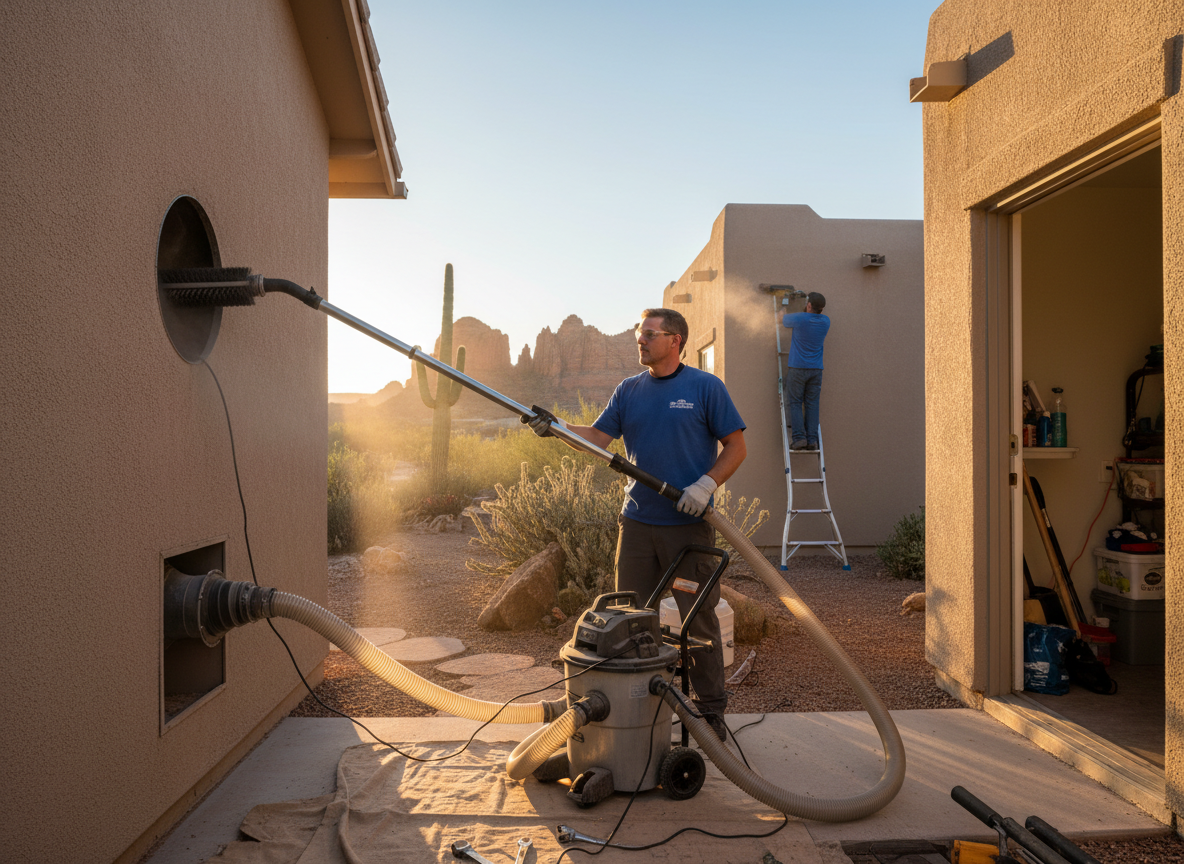
Camp Verde sits in Yavapai County where the high desert climate brings warm days and cool nights that cause ductwork to expand and contract daily. This movement loosens fine red dust that blows in from surrounding terrain and settles deep inside supply and return runs. Homes near Fort Verde State Historic Park and Montezuma Castle National Monument often have older duct systems with limited access points, making complete cleaning more involved than in newer builds. Technicians must account for attic insulation and tight crawl spaces common in Middle Verde properties when routing equipment.
Dryer vent cleaning requires special attention because lint mixes with the same desert dust and can create blockages along exterior wall runs or roof terminations. Many Camp Verde residences route vents through unconditioned attics where temperature swings accelerate buildup. We inspect the full path from dryer connection to exterior exhaust, removing lint and debris that restricts airflow and raises fire risk. Nearby towns like Cottonwood and Sedona share similar soil and wind patterns, so the same techniques apply when we handle jobs that cross into those areas.
Edge cases include homes with multiple dryer units or ducts that run under concrete slabs, both found in some Middle Verde properties. We use camera inspection first to map the layout before any equipment enters the system. This prevents damage to older flex duct or rigid metal sections weakened by years of dust abrasion. After cleaning, we verify airflow at each register and confirm the vent flap opens fully on the exterior.
Technician insight
In Camp Verde, the thing that catches most people out with air duct and dryer vent cleaning is how the fine red dust from the surrounding high desert terrain packs into older duct joints near Fort Verde State Historic Park. Homeowners often miss that the daily temperature swings loosen that packed dust over time, so a quick vacuum job never reaches the real buildup.
Restricted Dryer Vent in Middle Verde
A Middle Verde homeowner reported clothes taking twice as long to dry. Camera inspection showed lint mixed with red dust blocking the vent run through the attic. We cleared the full line and main trunk connection. Drying times returned to normal and the exterior flap operated freely.
How it works
- 1
Initial Camera Inspection
We run a camera through the main trunk lines and branch ducts to locate heavy dust or lint buildup before starting equipment.
- 2
Negative Air Setup
A HEPA-filtered vacuum is connected to create negative pressure so dislodged particles move only toward the collection point.
- 3
Agitation and Extraction
Rotating brushes and compressed air tools loosen debris from duct walls while the vacuum pulls it out of the system.
- 4
Dryer Vent Clearing
The vent line from the dryer to the exterior termination is cleaned separately and checked for proper flap operation.
- 5
Final Airflow Verification
Each register is tested for improved airflow and the system is returned to normal operation.
Pricing
Upfront quotes after inspection; cost depends on duct length, number of branches, and attic or crawl-space access.